Foreign Body Ingestion

---------------------------
Disclaimer: These guidelines should therefore not be considered to be a rule or to be establishing a legal standard of care. Caregivers may well choose a course of action outside of those represented in these guidelines because of specific patient circumstances. Furthermore, additional clinical studies  may  be  necessary  to  clarify  aspects  based  on  expert  opinioninstead  of  published  data.
----------------------------------------

      
Symptoms

Major Catagories of Ingestion management
In general for all objects in the esophagus, emergent removal is mandatory. Airway protection with ET Tube required (esp important if the patient has not been fasting >8hrs).
Depending on the position and NPO status of the patient, removal with McGill forceps by anesthesia or by ENT with a rigid scope may be considered alternatives to endoscopic removal.

Emergent
<2hrs from presentation
regardless of PO status
Urgent
<24hrs from presentation
following usual NPO guidelines
Elective
>24hrs from presentation
following usual NPO guidelines

Timing of Endoscopic Removal
Category
Location
Patient Symptomatic?
Timing
Button Battery
Esophagus
Yes or No
Emergent

Gastric/SB
YES
Emergent


No
Urgent - if Age < 5 and BB > 20mm


Elective - if not moving on serial films after 48hrs
Magnets
Esophagus
YES
Emergent - if not managing secretions (otherwise Urgent)


No
Urgent

Gastric/SB
YES
Emergent


No
Urgent
Sharp
Esophagus
YES
Emergent - if not managing secretions (otherwise Urgent)


No
Urgent

Gastric/SB
YES
Emergent - if signs of Perforation, then Surgery


No
Urgent
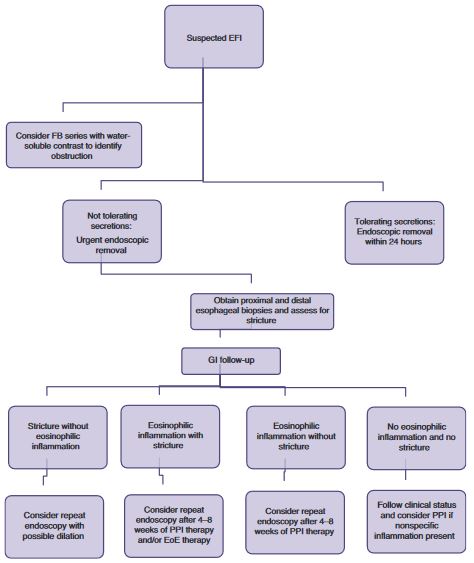
Food Impaction
Esophagus
YES
Emergent - if not managing secretions (otherwise Urgent)


No
Urgent
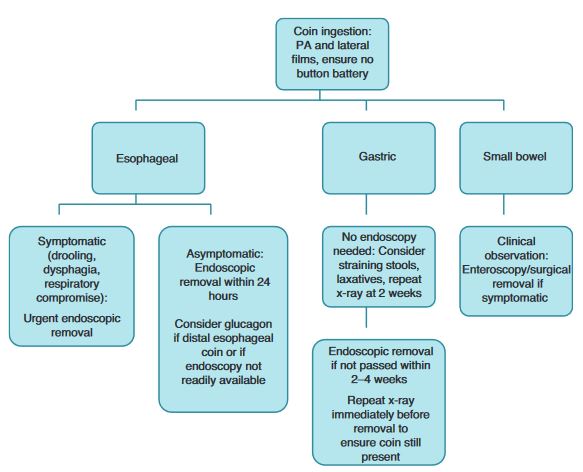
Coin
Esophagus
YES
Emergent - if not managing secretions (otherwise Urgent)


No
Urgent

Gastric/SB
YES
Urgent


No
Elective
Long Object
Esophagus
YES or No
Urgent

Gastric/SB
YES or No
Urgent
Absorptive Object
Esophagus
YES
Emergent - if not managing secretions (otherwise Urgent)


No
Urgent

Gastric/SB
YES or No
Urgent


Button Batteries


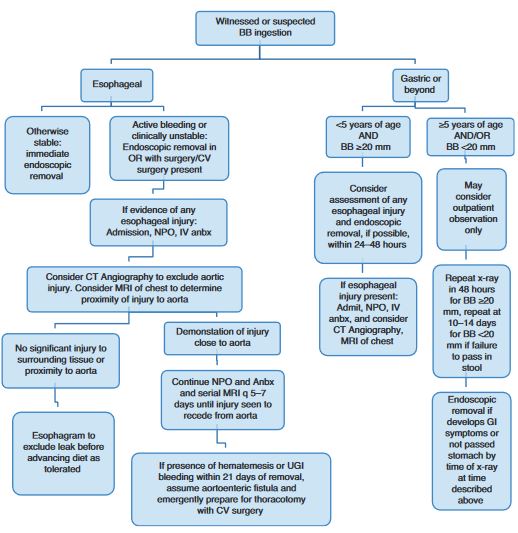
Lithium batteries with diameter >20mm pose the greatest risk with ingestion. Lithium batteries have increased voltage causing the generation of hydroxide radicals in the mucosa resulting in caustic injury from high pH. Animal models show rise in pH from 7 to 13 at the negative pole of the battery within 30min of ingestion. Necrosis of lamina propria may occur within 15min of ingestion and potential for stricture formation within 2hrs of ingestion. Continued injury may occur for days to weeks. Death from aortoenteric fistula reported up to 19 days after ingestion. 3x greater risk in new batteries vs old/spent batteries. Note that even used (non-operational) batteries contain enough residual charge to cause damage. Greatest risk for those < 5yo and battery > 20mm

Types of injuries:
Signs:
Removal:
Post removal management:

Magnets


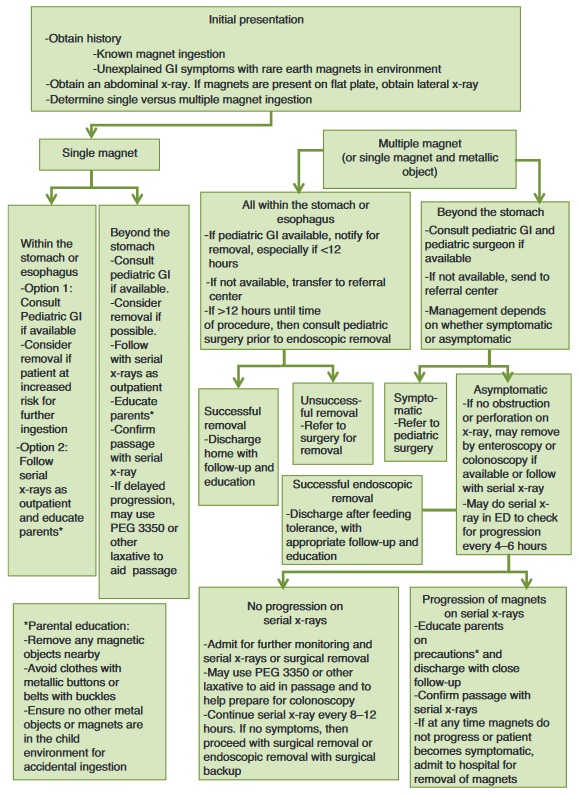
All magnets have the potential for injury but there is increased risk in magnets with neodymium or rare earth magnets. These magnets have 5x the risk of conventional magnets. The primary risk is the potential for enteroenteric fistula formation between magnets in adjacent loops of bowel with associated perforation, peritonitis, and bowel ischemia/necrosis.

Clear consensus that urgent removal of multiple magnet ingestions is indicated even in the asymptomatic patient when the location is amenable to endoscopic or colonoscopic retrieval

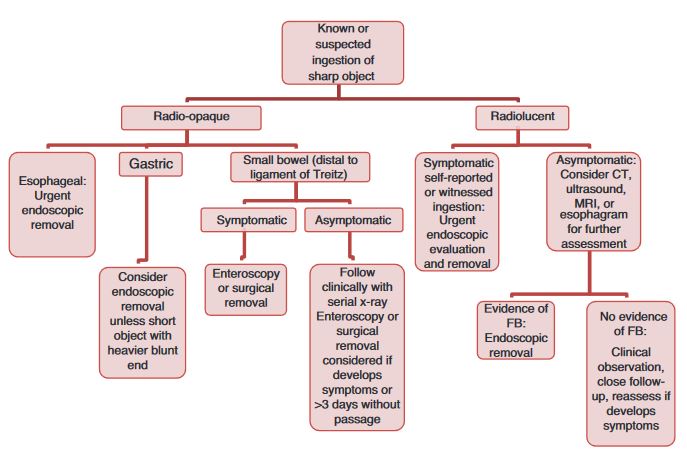
Sharp / Pointed Objects


Food Impaction


Coins / Blunt Objects


Coin >25mm unlikely to pass through pylorus
Long objects >6cm unlikely to clear duodenal sweep and/or ICV

(American and Canadian Quarters are 24mm)


Superabsorbant Objects

In the case of ingestion of beads or balls of superabsorbentpolymers,  such  as  the  Water  Balz  or  similar  product,  emergentendoscopic  removal  would  be  recommended.  Once  again,  thedevice used will depend on the size and shape of the object. Forround objects, a retrieval net or wire basket may be most effective.For larger, irregularly shaped objects, a polyp snare may be a betteroption.  Increased  time  of  ingestion  increases  both  the  depth  ofpassage and the amount of absorbed water.  Radiographic studiesbefore removal are unlikely to be helpful, because of the radiolucentnature of these objects. Contrast studies could potentially identifyareas of obstruction, but are likely to delay or complicate plans forendoscopic removal. As with other types of FBIs, examination ofother  objects  from  the  same  product  can  aid  in  the  planning  forremoval  and  help  assess  the  degree  of  risk.  In  patients  in  whomingestion is suspected  but  not witnessed,  the decision to  proceedwith  endoscopy  may  be  made  even  before  the  advent  of  clinicalsymptoms, depending on the level of suspicion. If upper endoscopicexamination fails to identify the object, a high degree of vigilancemust be reserved for the development of more distal bowel obstruc-tion. Surgical consultation and clinical observation may thereforebe advised, again depending on the level of suspicion that a trueingestion has occurred.

References:
Management of Ingested Foreign Bodies in Children:A Clinical Report of the NASPGHAN Endoscopy Committee NASPHAN paper on Foreign Body Ingestions